
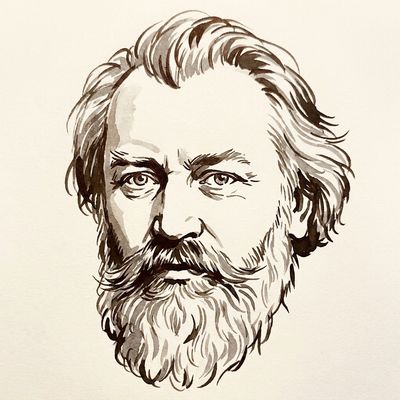
A German composer whose piano, chamber and orchestral works are noted for their structural rigour.
Johannes Brahms was born in Hamburg and made his early reputation with the help of Robert and Clara Schumann, who hailed the young composer as a coming master. He settled in Vienna and became the great standard-bearer of the Classical tradition in a Romantic age, admired for music of extraordinary craft and emotional depth. He was famously self-critical, destroying much that did not meet his standard.
Brahms’s piano music spans his whole life, from the storm and ambition of the early sonatas and variations to the introspection of the late intermezzos and rhapsodies. His writing is rich and full-handed — thick chords, cross-rhythms, warm inner voices — and it carries the structural discipline he learned from Bach and Beethoven. It rewards a player with patience and a singing tone.
The late short pieces, Opp. 116 to 119, are where many pianists first fall for Brahms; several of the intermezzos are within an intermediate player’s reach and deeply rewarding. The gentle Waltz in A♭ major, Op. 39 No. 15, is a well-loved first step. Brahms asks for feeling held under firm control.